

 Back to Blog
Discover where fulfillment errors originate, what they really cost, and how to catch them before they become expensive issues
Many shipping teams think about errors in terms of the immediate fix: sending a replacement order, printing a new label, or handling a customer complaint. However, those visible costs are often only a small fraction of the total impact. When you look deeper, there’s the labor to investigate and correct the mistake, expedited shipping for the replacement, returns processing, inventory adjustments, and retailer compliance penalties. Together, these costs can quickly add up to a significant expense.
These errors don’t all originate in the same place, and many go unnoticed until the order has already left the building. A wrong item picked from the shelf, a carton packed incorrectly, or a shipment sent with inaccurate data each creates different costs and requires a different fix. This post breaks down where each type of error starts, what it costs, and where verification checkpoints belong to catch errors before they reach your customers.
Three Errors, Three Origins
“Shipping error” is often used as an umbrella term, but it covers three distinct failures that happen at different points in the fulfillment process. Understanding the source of an error is critical to finding the most effective prevention methods.
- Mispick: A picking error occurs when the wrong item or quantity is pulled from inventory. This is commonly caused by similar SKUs stored in close proximity, unclear location labels, paper pick lists, or simple human error. A mispick happens before the order reaches the pack station, so unless it’s caught during packing, the order will ship wrong even if every later step is done correctly.
- Mispack: A packing error occurs when the right items are packed incorrectly. This can mean selecting the wrong carton, splitting items across cartons improperly, creating a mismatch between carton contents and the shipment record, or packing the contents with inadequate protection. These issues originate at the pack station and can affect both transportation costs and shipment accuracy.
- Mis-ship: A mis-ship occurs when the package is sent incorrectly. This can mean a wrong address, wrong carrier or service, misapplied labels, or shipment data that doesn’t accurately reflect the package’s contents. These errors are typically traced back to order data entered upstream or to the labeling step, which is why they can slip past physical inspection entirely.
Because each error starts at a different point, a verification checkpoint can only catch errors that happen at or before it. Effective prevention depends on placing checks at each stage where errors originate.
Containerization: Where Mispacks Begin
Before an order is packed, someone or something has to decide how it should be packed. That decision is part of containerization, the broader process of planning how goods are packed to eliminate wasted space, from individual cartons up to full pallets and trailers. At the carton level, it’s more commonly called cartonization: determining which carton an order ships in and how items are grouped across cartons. The two terms are often used interchangeably. Done correctly, it gives packers clear guidance on how each order should be built and shipped. Done poorly, or left to each packer’s judgment, the same order can be packed differently depending on who handles it and which carton sizes are on hand. That inconsistency increases the risk of packing errors, shipping inefficiencies, and compliance issues.
The most obvious consequence of poor containerization is cost. An oversized carton adds void space (“paying for air”), uses more packing material, and may raise dimensional (DIM) weight charges. A carton that’s too small can make products harder to pack safely, and grouping incompatible items together increases the risk of damage in transit. Determining carton sizes before the order is picked, using item dimensions, weight, and compatibility, removes that guesswork and allows items to be picked directly into the shipping carton. [Explore how cartonization shapes the modern customer experience.]
Less obvious, but often more costly, is the effect on accuracy. Containerization establishes which items belong in each carton, and carton labels, shipping documents, and advance ship notices (ASNs) all depend on that carton-level data. If the physical contents don’t match the shipment record, every document built from that record is wrong too.
A shipment can arrive on time with every correct product and still create costly problems. For example, many retailers scan cartons at receiving. When the contents don’t match the ASN, the mismatch surfaces at the dock. For many B2B shippers, this is where chargebacks and compliance disputes begin.
What an Error Actually Costs
The cost of a fulfillment error depends heavily on where it’s caught. A picker who notices the wrong item can correct the mistake in seconds. A packer who spots an issue before sealing the carton may only need to rework the order. But once the shipment leaves the building and the customer finds the error, the work spreads across the operation, from investigating the issue to correcting inventory records. The total cost is the sum of all of it.
Direct Costs
Direct costs are the expenses tied to correcting the error. These can include labor to investigate, repick and repack the order, generate new shipping documents, and ship a replacement, often with expedited service to meet the original delivery commitment. If the original order is returned, return freight, receiving labor, inspection time, and restocking costs add to the total. When poor packing causes damage, replacement products and damage claims add even more expense.
Indirect Costs
Indirect costs are harder to measure, and their effects can have significant long-term impact. Customer service teams spend time handling calls and emails, finance teams issue credits and refunds, and warehouse staff investigate discrepancies. Inventory accuracy can suffer as well. When the wrong item ships, on-hand counts for multiple SKUs may be incorrect until the issue is identified and reconciled, increasing the risk of stockouts or overselling. In B2B environments, errors can also trigger retailer penalties and strain trading partner relationships. Even when a problem is ultimately resolved, each mistake can erode customer confidence and increase the likelihood of lost future business.
Because error costs spread across departments, systems, and customer relationships, they rarely show up as a single line item. That makes it hard for many operations to see what errors actually cost them. A mispick, mispack, and mis-ship may produce similar customer complaints, but each creates different operational and financial consequences. Before investing in prevention, shippers should understand which types of errors are happening most often and which are costing the most.
Calculate Your Own Annual Error Cost
No benchmark can tell you what errors are costing your business. That number depends on factors such as your order volume, product values, customer requirements, and which types of errors occur most frequently. One way to establish a baseline is to calculate the annual cost of errors using the following equation:
Annual error cost = (annual orders × error rate × average cost per error) + annual chargebacks
For example, say a shipper processes 500,000 orders per year with a 0.5% error rate and estimates the average cost of each error at $35. If retailer chargebacks total $50,000 annually, the calculation would look like this:
- 500,000 annual orders × 0.5% error rate = 2,500 errors
- 2,500 errors × $35 per error = $87,500
- $87,500 + $50,000 in chargebacks = $137,500 annual error cost
Error costs also scale with volume. If the same shipper grows to 1,000,000 orders at the same error rate, its errors double to 5,000, and the cost of correcting them doubles to $175,000 before chargebacks. An error rate that seems acceptable today can become a significant expense as the business grows.
It’s important to split costs by error type and run the calculation separately for mispicks, mispacks, and mis-ships, then add chargebacks once to the combined total. The most common error isn’t always the most expensive one, and separate calculations make it easier to see where improvements will have the greatest effect.
Where Verification Belongs
Once you know which errors cost the most, the next step is placing verification checkpoints at the points where each error type is most likely to originate.
At the Pick: Verify the Right Item
During picking, scanning each item’s barcode confirms it matches the order before it reaches the pack station. Location scans confirm the picker is at the right bin, which addresses common mispick causes like similar SKUs stored near each other and unclear location labels.
At the Pack Station: Reconcile Contents and Shipment Data
The pack station is the final point where the order’s physical contents and its shipment data can be checked against each other. By scanning items into specific cartons as they are packed, teams can confirm that the right products, quantities, and carton assignments are recorded before the order moves downstream. Just as important, shipment documents should be generated from the verified packing activity itself. When carton labels, packing lists, and ASNs are created from what was actually packed, the shipment record reflects reality rather than assumptions made earlier in the fulfillment process.
At Shipping: Validate the Final Shipment
Before a package leaves the facility, shipping systems can perform a final validation. Comparing actual carton weight to expected weight can help identify missing or extra items, while address, carrier, and service-level validation helps catch mis-ships caused by incorrect order data. Since weight checks can’t detect every issue, they work best as a final safeguard rather than a replacement for pick and pack verification.
The Limits of Verification
Every checkpoint compares something physical to a value in a system, such as a barcode, a carton’s contents, or an expected weight. If item data in the product master is wrong, incorrect shipments can pass validation. Accurate item data is what makes each of these checks reliable.
Planning and Verifying Cartons with Varsity Logistics
Preventing fulfillment errors is easiest when picking, packing, shipment data, and carrier compliance run in one connected system. Varsity Logistics provides multi-carrier parcel and freight shipping software built for IBM i, with modules that standardize packing decisions, verify carton contents, and reduce the costs of mispicks, mispacks, and mis-ships.
Standardized Packing Decisions
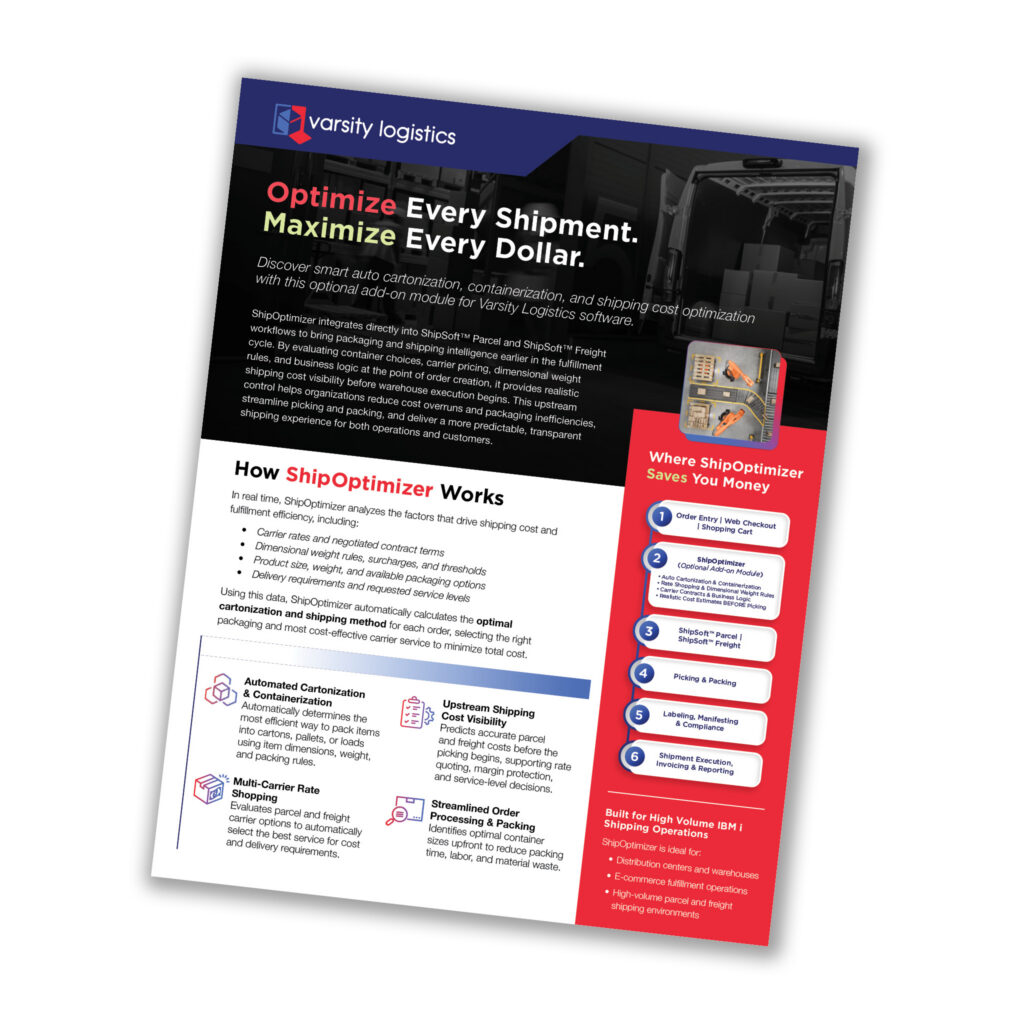
Varsity ShipOptimizer automates containerization by analyzing item dimensions, weight, and compatibility to determine the most efficient way to pack an order before it reaches the pack station. By standardizing carton selection and item placement, organizations can reduce shipping costs, improve consistency, and eliminate many of the manual decisions that contribute to packing errors.
Packing Verification
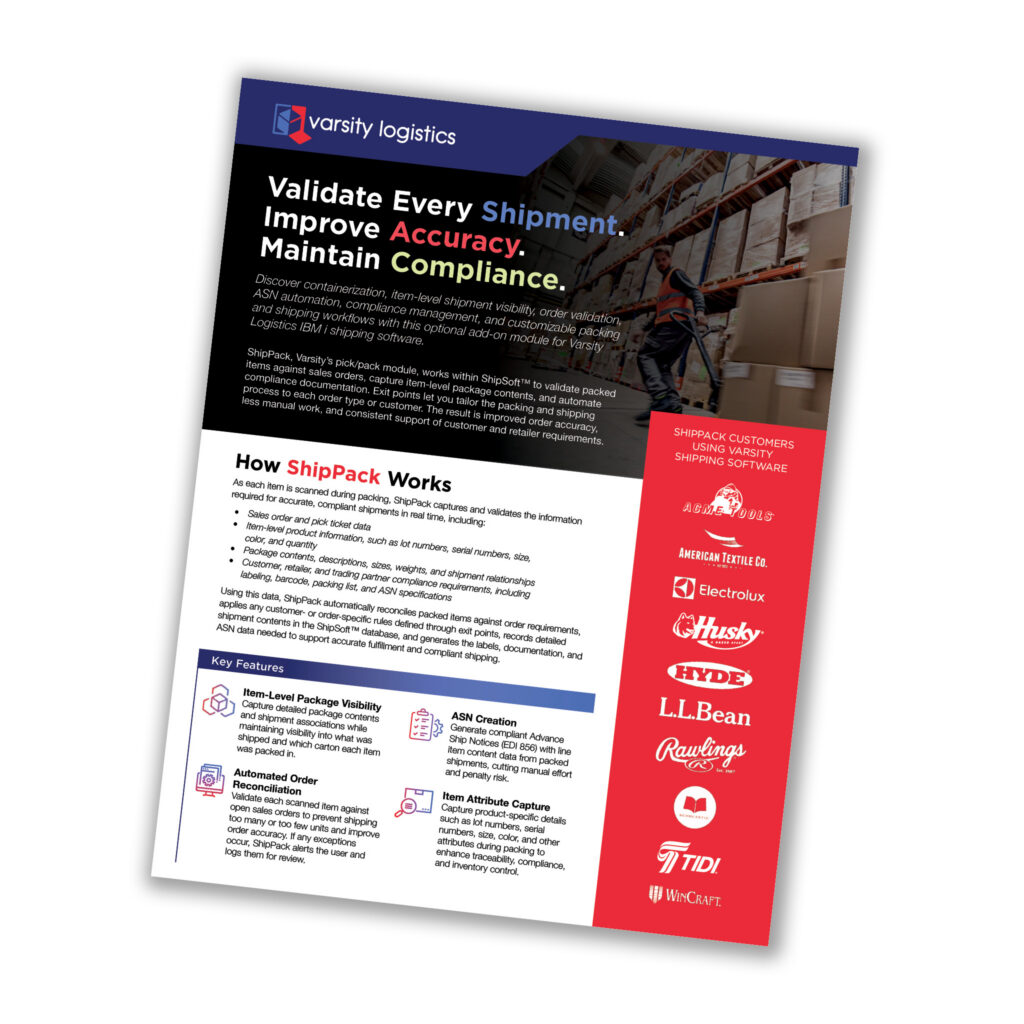
Varsity ShipPack verifies what was actually packed. As cartons are built, it captures item-level details and reconciles them against the pick ticket, confirming that every item is in the right carton before the order moves on. It automatically generates ASNs, UCC 128 labels, and other compliance documents from the verified contents, so the shipment record reflects what was packed. For operations with unique customer requirements, ShipPack workflows can be configured by trading partner, item, or location to support specific packing and labeling rules.
Together, these tools cover both sides of carton accuracy: planning how each order should be packed and verifying that it was packed that way, within the same IBM i environment where many shippers already manage their orders and item data.
Price Your Errors Before They Price You
Fulfillment errors are expensive and easy to underestimate. The key is identifying where those errors originate and implementing the controls needed to catch them before they ship.
If mispacks, carton content mismatches, or retailer chargebacks are driving your error costs, schedule a demo with a Varsity shipping expert to see how Varsity Logistics can help you plan, verify, and document every carton within your IBM i environment.